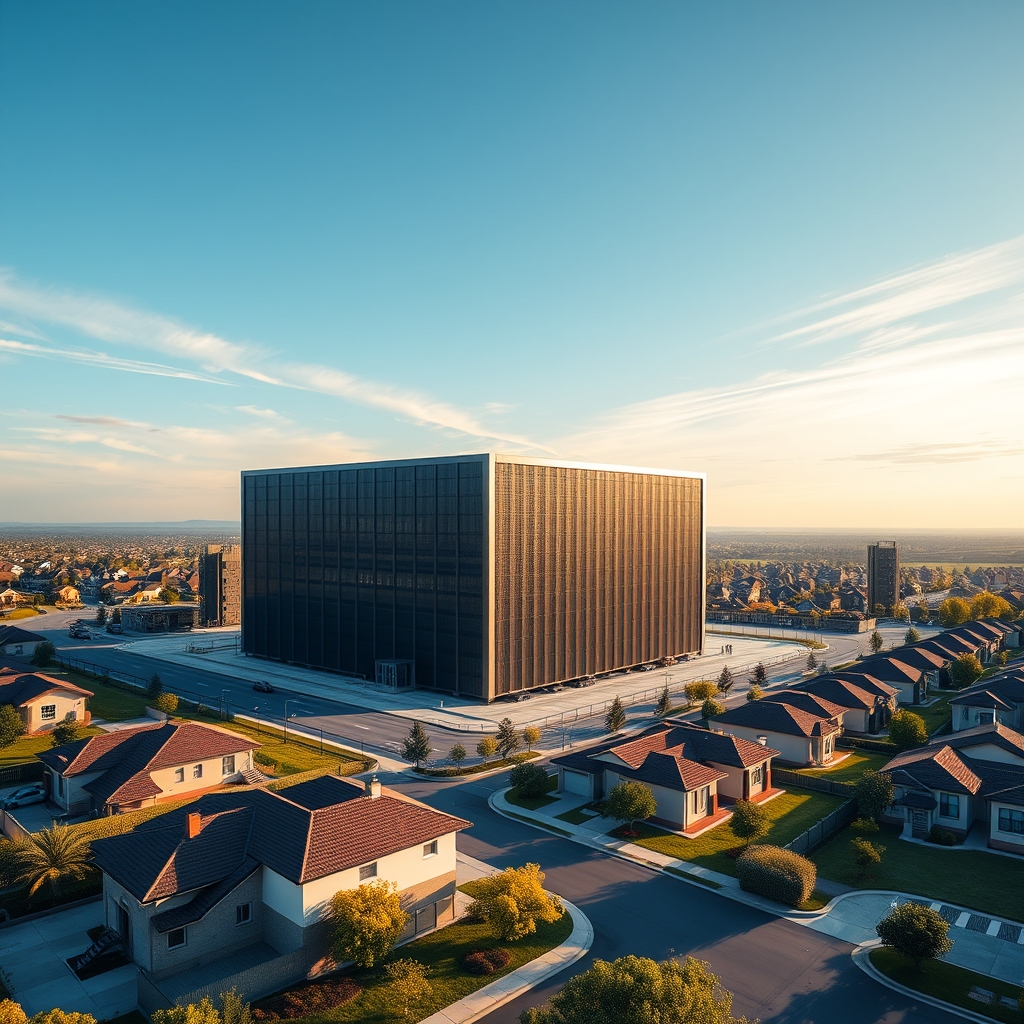
A historic shift is reshaping the American economic landscape as capital flows pivot dramatically away from residential real estate and toward the rapid expansion of artificial intelligence infrastructure. According to recent federal economic figures, inflation-adjusted spending on information-processing hardware and data centers has officially overtaken traditional housing investments for the first time, marking a pivotal transformation in what drives national economic growth.
Data compiled by the Bureau of Economic Analysis reveals that real private residential fixed investment stood at $748 billion during the second quarter, reflecting an 18% decline from its peak in early 2021. In stark contrast, spending on information processing equipment—which encompasses massive data centers and advanced computer hardware required to power modern AI models—has climbed 51% over the same timeframe to reach $752 billion. Adam Shapiro, vice president at the Federal Reserve Bank of San Francisco, highlighted this historic transition in a recent professional network post, noting that the broader economy is witnessing a fundamental reallocation of resources toward computing power.
This massive divergence underscores the starkly different pressures currently facing the tech and real estate sectors. While the housing market has remained largely frozen since the conclusion of the COVID-era boom in 2022, major technology firms often referred to as hyperscalers have aggressively poured capital into building out AI capabilities as quickly as possible. The Federal Reserve’s aggressive interest rate hiking campaign, initiated to combat inflation, drove the benchmark 30-year mortgage rate near 7% as 10-year Treasury yields reached their highest levels since 2007. This environment severely hobbled residential housing construction and triggered a lock-in effect among homeowners reluctant to abandon low mortgage rates.
Conversely, the AI investment boom has demonstrated a remarkable insulation from elevated borrowing costs. Treasury Secretary Scott Bessent recently pointed out that major corporations are issuing debt with a yield-agnostic mindset, driven by the belief that the long-term returns on AI infrastructure will far outweigh the current cost of capital. Tech giants are aggressively tapping debt markets to supplement their cash reserves, with some major players even reporting negative cash flow as they scale up operations to meet projected demand.
Financial analysts expect this extraordinary wave of capital expenditure to accelerate further before plateauing. Projections from S&P Global indicate that capital expenditures from leading technology enterprises—including Alphabet, Amazon, Microsoft, Meta, Oracle, and SpaceX—will surpass $1.3 trillion in 2027, climbing significantly from projected figures of $870 billion in 2026 and $470 billion in 2025. However, ratings agencies have issued warnings that this breakneck build-out is expanding faster than immediate revenue growth, which could potentially result in temporary overcapacity if future market demand fails to keep pace.
The rapid proliferation of data centers has also triggered notable societal and political repercussions. Communities across the nation are increasingly pushing back against large-scale infrastructure projects due to concerns over local resource consumption and rising utility costs. At the same time, consumers continue to face broader cost-of-living pressures, exacerbated by elevated electricity bills and constrained housing availability. As developers grapple with high borrowing costs and steep construction expenses, housing starts continue to falter, reinforcing a complex economic dichotomy where digital infrastructure thrives while traditional residential development struggles to find momentum.
Source: Fortune